Trade And Finance Domain
Trade and Finance Domain Explained: A Practical Guide for Interview Preparation
Trade and finance play a critical role in enabling global commerce. From small exporters to multinational corporations, businesses rely on trade finance solutions to reduce risk, ensure timely payments, and maintain healthy cash flow. For candidates preparing for banking, trade operations, or fintech interviews, understanding this domain is a strong differentiator.
This blog breaks down the trade and finance domain in a simple, interview-friendly way.
1. What Is the Trade and Finance Domain?
The trade and finance domain covers financial instruments, processes, and systems that support domestic and international trade. It helps buyers and sellers transact safely, even when they operate in different countries with varying regulations and risks.
Core objectives include:
Reducing payment and delivery risk
Providing working capital to businesses
Ensuring trust between trading partners
Supporting regulatory and compliance requirements
2. Key Trade Finance Instruments
Interviewers often test understanding of common trade finance products.
Letter of Credit (LC)
Bank guarantees payment to the seller if conditions are met
Reduces risk for both buyer and seller
Bank Guarantee
Bank promises compensation if contractual obligations are not fulfilled
Documentary Collections
Banks handle trade documents and payments without guaranteeing funds
Trade Loans & Financing
Pre-shipment and post-shipment financing
Invoice discounting and supply chain finance
3. End-to-End Trade Finance Flow
A typical trade finance transaction includes:
Trade agreement between buyer and seller
Issuance of trade instrument (LC or guarantee)
Shipment of goods
Presentation and verification of documents
Payment, settlement, and reconciliation
Understanding this lifecycle helps candidates answer scenario-based questions effectively.
4. Key Documents in Trade Finance
Documentation is central to trade finance.
Common documents include:
Commercial invoice
Bill of lading / Airway bill
Packing list
Insurance certificate
Certificate of origin
Banks verify documents strictly, often under rules like UCP 600.
5. Risks and Compliance in Trade Finance
Trade finance involves multiple risks:
Credit risk
Country and political risk
Fraud and document discrepancies
Compliance areas include:
KYC and AML checks
Sanctions screening
Trade-based money laundering (TBML) prevention
Awareness of these risks is highly valued in interviews.
6. Technology and Digital Trade Finance
Modern trade finance is increasingly digital.
Key trends:
Electronic documents and e-Lading
Blockchain-based trade platforms
Integration with core banking and payment systems
Automation of document checking
Digital transformation is a common interview discussion topic.
7. Roles in the Trade & Finance Domain
Different roles contribute to trade finance projects:
Business Analysts define workflows, rules, and compliance needs
Product Owners prioritize trade finance features and enhancements
Operations Teams handle execution and document processing
Understanding role interactions adds practical depth to your knowledge.
Final Thoughts
The trade and finance domain combines banking expertise, international regulations, documentation, and technology. For interview success, focus on understanding instruments, end-to-end flows, risks, and compliance rather than memorizing definitions.
Strong trade finance knowledge can open doors to roles in banking, fintech, and global trade operations.
Trade & Finance Products – End-to-End Guide
Purpose of Trade & Finance
International trade involves multiple risks:
Buyer may not pay
Seller may not ship as agreed
Country, currency, and regulatory risks
Cash flow constraints
Trade finance products exist to:
Reduce payment & performance risk
Enable secure exchange of goods, documents, and money
Provide working capital financing
Support trust between unknown counterparties
End-to-End Trade Flow (Big Picture)
Commercial Contract
↓
Trade Finance Instrument Selected
↓
Goods Manufactured / Shipped
↓
Documents Created & Exchanged
↓
Payment / Financing
↓
Goods Released to Buyer
The instrument chosen (LC, BG, Collection, or Loan) determines risk level, cost, and complexity.
1. Letters of Credit (LC)
What is a Letter of Credit?
A Letter of Credit (LC) is an irrevocable commitment by a bank to pay the exporter, provided the exporter presents documents that strictly comply with LC terms.
📌 Key idea:
Banks deal in documents, not goods.
When is LC Used?
New or high-risk trading relationships
High-value transactions
Cross-border trade
Country or political risk exists
Key Parties in LC
Applicant – Importer (Buyer)
Issuing Bank – Buyer’s bank
Advising Bank – Seller’s bank
Beneficiary – Exporter (Seller)
Confirming Bank (optional)
LC End-to-End Flow (Visual)
1. Sales Contract Signed
Importer ↔ Exporter
│
2. LC Application
Importer → Issuing Bank
│
3. LC Issued
Issuing Bank → Advising Bank → Exporter
│
4. Goods Shipped
Exporter → Shipping Company
│
5. Documents Submitted
Exporter → Advising Bank
│
6. Document Check
Advising Bank → Issuing Bank
│
7. Payment
Issuing Bank → Advising Bank → Exporter
│
8. Goods Released
Importer collects goods using documents
Documents Under LC
Commercial Invoice
Bill of Lading / Airway Bill
Packing List
Certificate of Origin
Insurance Certificate
Inspection Certificate
📌 Any discrepancy = payment delay or rejection
Types of LCs (Common)
Irrevocable LC – Cannot be changed unilaterally
Confirmed LC – Additional guarantee from seller’s bank
Standby LC (SBLC) – Acts like a guarantee
Transferable LC – Used in intermediary trade
Back-to-Back LC – For traders using one LC to open another
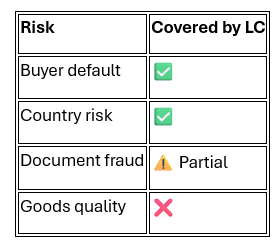
Risk Coverage
2. Bank Guarantees (BG)
What is a Bank Guarantee?
A Bank Guarantee is a bank’s promise to pay the beneficiary if the applicant fails to meet contractual obligations.
📌 Unlike LC, payment happens only if default occurs.
When is BG Used?
Construction & infrastructure projects
Tenders & bids
Long-term contracts
Advance payments
Key Parties
Applicant – Party providing guarantee
Issuing Bank
Beneficiary
Bank Guarantee Flow (Visual)
1. Contract Signed
Applicant ↔ Beneficiary
│
2. BG Issued
Applicant → Issuing Bank → Beneficiary
│
3. Contract Performance
Applicant performs obligations
│
4A. If successful → BG expires
4B. If default → Beneficiary claims BG
│
5. Bank Pays Beneficiary
Types of Bank Guarantees
Performance Guarantee
Financial Guarantee
Advance Payment Guarantee
Bid Bond
Retention Guarantee
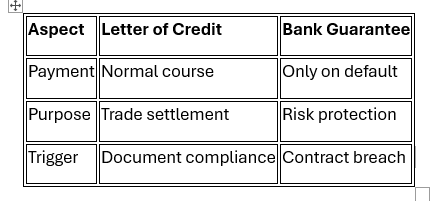
Key Difference: LC vs BG
3. Documentary Collections
What are Documentary Collections?
Documentary Collections involve banks exchanging documents against payment or acceptance, without guaranteeing payment.
📌 Banks act as facilitators, not guarantors.
When Used?
Trusted trading relationships
Lower transaction value
Cost-sensitive trade
Types of Documentary Collections
1. Documents Against Payment (D/P)
Exporter ships goods
↓
Documents sent to Importer Bank
↓
Importer pays
↓
Documents released
2. Documents Against Acceptance (D/A)
Exporter ships goods
↓
Importer accepts time draft
↓
Documents released
↓
Payment made on maturity date
Documentary Collection Flow (Visual)
Exporter → Exporter Bank → Importer Bank → Importer
↑ ↓
Payment / Acceptance
4. Trade Loans & Trade Financing
What is Trade Financing?
Trade financing provides short-term funding to support trade before or after shipment.
📌 Focus is liquidity, not risk mitigation.
Types of Trade Loans
1. Pre-Shipment Finance
Used before goods are shipped.
Order Received
↓
Bank funds production
↓
Goods manufactured
2. Post-Shipment Finance
Used after goods are shipped.
Goods shipped
↓
Exporter receives financing
↓
Payment received later
3. Import Loans
Importer receives goods
↓
Bank pays exporter
↓
Importer repays bank later
4. Buyer’s Credit
Loan to importer (usually foreign currency)
Reduces cost for buyer
5. Supplier’s Credit
Exporter extends credit to importer
Often supported by banks
Trade Finance + Payments Integration
Trade Instrument (LC / BG / Collection)
↓
Payment Execution
(SWIFT / ISO 20022 / SEPA / RTGS)
Trade finance initiates obligation, payments move funds.
How Banks Process Trade Transactions
KYC & AML checks
Sanctions screening
Document verification
Risk assessment
Compliance (UCP 600, URDG 758, URC 522)
Accounting & settlement